
News

Atlantic Immigration Program
Atlantic Immigration Program Drives Economic Growth and Attracts Skilled Workers
News Release
March 4, 2022—Ottawa – Immigration is vital to the future of communities across the country, and nowhere more so than in Atlantic Canada. The Atlantic Immigration Pilot welcomed over 12,700 newcomers across the region, strengthening our communities and helping our businesses succeed. We announced the new permanent Atlantic Immigration Program, recognizing the need to build on this success as we continue to recover from the pandemic and address labour shortages across Atlantic Canada.
Today, the Honourable Sean Fraser, Minister of Immigration, Refugees and Citizenship, announced that applications for the permanent Atlantic Immigration Program will launch on March 6, 2022. Candidates with a valid endorsement from an Atlantic Canadian business will now be able to submit applications for permanent residence under the new permanent program. This dynamic program will help the Atlantic provinces attract more skilled newcomers to fuel our economic recovery and drive further growth in the region.
Since 2017, participating employers have made over 9,800 job offers in key sectors, including in health care, manufacturing, accommodations and food services. More significantly, over 90% of applicants were still living in the region after a year. This is a testament to the resilient and welcoming nature of Atlantic Canadian communities.
The Atlantic Immigration Program helps establish Atlantic Canada as a leading destination for skilled workers and international graduates. It responds directly to the region’s acute demographic and economic challenges, and will help build a vibrant and prosperous future for Atlantic Canada.
Immigration, Refugees and Citizenship Canada continues to work closely with employers and provincial governments to ensure a smooth transition between the pilot and the permanent program.
Quotes
“Newcomers have played a key role in strengthening communities across Atlantic Canada and helping businesses succeed. By working closely with employers and our provincial partners, the Atlantic Immigration Program will attract highly skilled workers and international graduates to our region, and it will help rebuild our economy, address our labour shortage and build a prosperous future for Atlantic Canada.”
– The Honourable Sean Fraser, Minister of Immigration, Refugees and Citizenship
Quick facts
- As part of the Government of Canada’s Atlantic Growth Strategy, the Atlantic Immigration Pilot aimed to accelerate the growth of Atlantic Canada’s economy and was designed to test new approaches to attract and retain skilled immigrants in the region. It responded to the region’s acute demographic and economic challenges, including slow growth, chronic labour market shortages, an aging workforce, and difficulty attracting and retaining immigrants.
- The Atlantic Immigration Pilot is now closed; applications are no longer being accepted.
- The regulations for the permanent Atlantic Immigration Program came into force on January 1, 2022.
- With at least 6,000 admission spaces available yearly, the Atlantic Immigration Program will complement the Provincial Nominee Programs in each Atlantic province.
- In 2018–2019, the Atlantic provinces saw their highest population growth since the 1970s, with immigration, including from the pilot, being the main driver of this trend.
Associated links

Canada welcomes over 108,000 permanent residents in early 2022
March 31, 2022—Ottawa—Immigration benefits all Canadians by driving our economy, addressing labour shortages, and strengthening our communities. In response to the large volume of applications, Immigration, Refugees and Citizenship Canada (IRCC) has been improving its operations, adding resources where they are needed most, and streamlining processes that provide clients with the experience they expect and deserve.
Today, the Honourable Sean Fraser, Minister of Immigration, Refugees and Citizenship, announced that IRCC surpassed its goal to make 147,000 permanent residence final decisions in the first quarter of 2022—doubling the number of final decisions in the same time period in 2021. Through these efforts, Canada has welcomed over 108,000 new permanent residents so far this year.
In addition, Canada has exceeded its citizenship goals for 2021–2022, with over 210,000 new Canadian citizens. IRCC is modernizing and increasing its services for people who want to become Canadians, including offering online testing, virtual citizenship ceremonies, and an online application tracker to stay updated on their files.
These new achievements are the result of IRCC’s ongoing commitment to improving client service. IRCC made over half a million decisions and welcomed over 405,000 new permanent residents in 2021—the greatest number of newcomers in a year in Canadian history. Following a record year for study permits in 2019, IRCC increased its output by 32% in 2021 by finalizing almost 560,000 study permit applications. In the same year, nearly 169,000 applicants—a record number—made the transition from worker status to permanent residence in Canada.
Supported by additional funding of $85 million from the 2021 Economic and Fiscal Update, we are continuing our efforts to reduce application inventories accumulated during the pandemic. The funding builds on the work that has already been done to reduce wait times, such as hiring new processing staff, digitizing applications, and reallocating work among our offices around the world.
As we strive to reduce application processing times, IRCC remains dedicated to providing meaningful, timely, and transparent information to its clients. Today, the Minister also announced new updates to IRCC’s online processing times tool to provide clients with more accurate estimates of how long it will take to process their application. Most permanent residence and citizenship services will now use dynamic processing times, with updated calculations posted weekly, based on data from the previous 6 months. Dynamic processing times for temporary residence services are already in place, based on data from the past 8 or 16 weeks.
These changes will provide realistic and up-to-date information for clients, and will reflect the volumes of applications being processed as well as the latest operational realities. They will allow those who want to come to Canada to live, work, and study to make plans based on a more accurate timeline. We continue our work to digitize and modernize how we deliver our programs and services, so Canada can continue to be a destination of choice for people all over the world.
Quotes
“While navigating unprecedented challenges in Canada’s immigration system, we have kept client experience as our focus, leading to record levels of newcomers in Canada. Helping clients come to Canada quickly, with predictable processing times and efficient communication, remains a top priority for me. Canada is proud to be a destination of choice for so many people around the world, and we will continue to work hard to provide the best experience possible for them.”
– The Honourable Sean Fraser, Minister of Immigration, Refugees and Citizenship
Quick facts
- On January 31, 2022, Minister Fraser announced new measures to improve client experience and modernize the immigration system. This included a goal to make 147,000 permanent residence final decisions in the first quarter of 2022.
- In the 2021 Economic and Fiscal Update, the Government of Canada proposed $85 million in new funding to reduce application inventories. The investment will support additional staff, helping IRCC to welcome people who can help address labour shortages and to return to processing service standards in various programs, including for study permits, work permits and permanent resident card renewals. IRCC is also working to reduce processing times for visitor visas and proof of citizenship.
- In February 2022, IRCC launched a new digital case status tracker that allows some family class permanent residence applicants, sponsors and their representatives to more easily check their application status online. For the initial launch, the tracker is available for permanent residence applicants in the spouse, partner and dependent child categories.
- IRCC began holding virtual citizenship ceremonies on April 1, 2020. Between April 1, 2020, and January 31, 2022, more than 198,900 people took the Oath of Citizenship in more than 12,400 ceremonies using a virtual platform.
Associated links

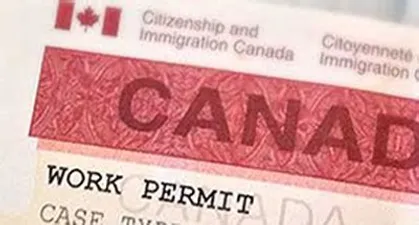
Work Permits for Visitors
Visitors in Canada can apply for a work permit and request Interim Authorization to Work if they held a valid work permit in the last 12 months
Temporary Resident Visa (TRV) holders who are in Canada and want to apply for a work permit can now do so until February 28, 2023. These changes are related to the Government's efforts to respond to the economic impacts of COVID-19. These Interim Authorizations to work must be supported by a job offer without leaving the country.
Visitors to Canada who hold Temporary Resident Visa or are from a visa-exempt country can apply for employer-specific work permits from inside Canada. This policy it also allows eligible visitors to start working before even receiving the work permit.
This is a temporary regulatory change as normally foreign workers who are in Canada on a TRV cannot change status without leaving the country.
Eligibility criteria for visitors applying for employer-specific work permits
In order to be eligible, a foreign national must:
- be in Canada;
- have submitted an employer-specific work permit application using the Application to Change Conditions, Extend my Stay or Remain in Canada as a Worker [IMM 5710];
- have stayed in Canada with status since submitting the application;
- submit the application before February 28, 2023.
Interim Authorization to Work
Prior to the pandemic, if you were a TRV holder, you could not apply for a work permit from within Canada. Instead, you could submit a work permit application while in Canada to your country of origin’s visa office. If your work permit was approved, you needed to physically leave Canada and re-enter for the work permit to take effect.
Due to COVID-19 measures, people could no longer flagpole. Flagpoling is when you leave Canada and return for the purposes of activating a temporary status. As such, in August 2020 Immigration, Refugees and Citizenship Canada (IRCC) started allowing TRV holders to submit work permit applications to IRCC from within Canada.
Although you can apply for a work permit from within Canada, you cannot work until IRCC approves the work permit. According to the IRCC website, this can take about 132 days.
In order to address this issue, IRCC introduced what is called an “Interim Authorization to Work.” Assuming you meet the eligibility criteria, you can get this authorization quickly. It enables you to begin working while IRCC processes your work permit application. The purpose is to enable those with an employer-specific job offer to begin work immediately. It is also intended to address labour shortages given the prolonged length of time it is taking IRCC to process work permit applications submitted inside the country.
One of the reasons IRCC is prioritizing people who held a work permit in the last 12 months is to help those who may have been laid off during the pandemic get back into the labour market more quickly.
A person’s work permit application can be rejected while on an Interim Authorization, but if the work permit application is approved, Interim Authorization allows TRV holders to start working more quickly than if they had to wait for a firm approval.
Eligibility Criteria for Interim Authorization
Interim Authorization is not automatic. If you’re a visitor who is applying for a work permit in Canada and held a valid work permit in the last 12 months you can ask to be allowed to work while IRCC processes your application.
To meet the eligibility criteria you must:
- be physically present in Canada when you apply;
- be a visitor with valid status when you apply for the work permit;
- if your visitor status has expired, you’ll need to restore your visitor status before you apply for a work permit;
- applied for an employer-specific work permit between August 24, 2020, and February 28, 2023; and
- have held a work permit that was valid in the 12 months before you applied for a new work permit.
It is then a two-step process to get interim authorization.
Step 1: Contact IRCC
After you apply for your work permit, fill out the IRCC Web form.
When you fill out the “Your enquiry” section, copy the text: Message to request interim authorization to work
Make sure you fill out the sections in square brackets, including the:
- dates;
- work permit number (begins with a “U”);
- name of your employer; and
- title of your job.
If you applied on paper and don’t know your application number, include your courier tracking number. This will ensure IRCC can find your application.
If you have other questions, you need to fill out a new IRCC Web form.
Step 2: Wait for IRCC to contact you
You must wait for IRCC to email you to let you know that you can start working. This may take up to 30 business days, which is about six weeks.